
Latest Products



Contact Us
- No.173 Xingqiao North Road, Yuhang District, Hangzhou, Zhejiang 31100, China
- jeson@gordon-elec.com
- +86-0571-8853 8375

Standard Zip Ties
Standard zip ties, also known as cable ties or nylon ties, are versatile and widely used fastening tools in various industries, households, and commercial settings. These ties are typically made from durable nylon material, known for its strength, flexibility, and resistance to environmental factors such as UV radiation and moisture. Due to their simple design and ease of use, zip ties have become an essential tool for tasks such as cable management, bundling objects, securing items, and much more.
Hangzhou Gordon Electric Co., Ltd. is one of the most reliable manufacturers and suppliers of standard zip ties in China, also supports custom service. Please feel free to wholesale advanced standard zip ties made in China here from our factory.
Construction and Materials
T consist of a long, thin strip with a series of serrations or teeth along one side and a small, box-shaped head at one end. The head features a locking mechanism, usually a ratchet or pawl, which engages with the teeth on the strip when the free end is inserted into the head. As the strip is pulled through the head, the locking mechanism allows it to move in only one direction, creating a secure loop that cannot easily be undone. This design ensures a tight and secure hold on the objects being bundled.
The most common material used in zip ties is nylon 6/6, which offers a good balance of strength, flexibility, and cost-effectiveness. Nylon 6/6 is resistant to many chemicals, oils, and greases, making it suitable for a wide range of environments. Additionally, it has a high melting point, which allows zip ties to maintain their integrity even in relatively high-temperature applications. For outdoor use, UV-resistant variants are available, which are specially formulated to withstand prolonged exposure to sunlight without degrading.
Considerations and Limitations
While zip ties are incredibly useful, there are some considerations to keep in mind. Over-tightening a zip tie can damage the materials it is securing, particularly cables, which could lead to signal interference or breakage. Additionally, most standard zip ties are single-use, meaning that once they are cut, they cannot be reused. For applications where reusability is important, reusable zip ties with a release mechanism are available.
In extremely high-temperature environments or in situations where resistance to fire is critical, standard nylon zip ties may not be suitable, and specialized materials such as stainless steel or Teflon-coated ties might be required.


| Material: | Made of high quality Nylon 66, UL Flammability 94V-2 |
| Structure: | The design of head guarantee a high tensile strength while allowing a low insertion and pull through force. Rounded safety edges eliminate insulation damage |
| Color: | Natural/Black, other color could customized |
| Working temperature: | Applied from -40℃ to 85℃ |
| Length: | All lengths are available |
| width: | 2.5mm/ 3.6mm/ 4.8mm/ 7.2mm/ 9.0mm/ 12.0mm |
| Feature: | Flame-retardant(94V-2), Heat-resistant, UV resistant are available. |
| Certificate: | RoHS, CE, Material UL Test, UV Resistance Test, Flame Retardant Test, High And Low Temperature Test. |
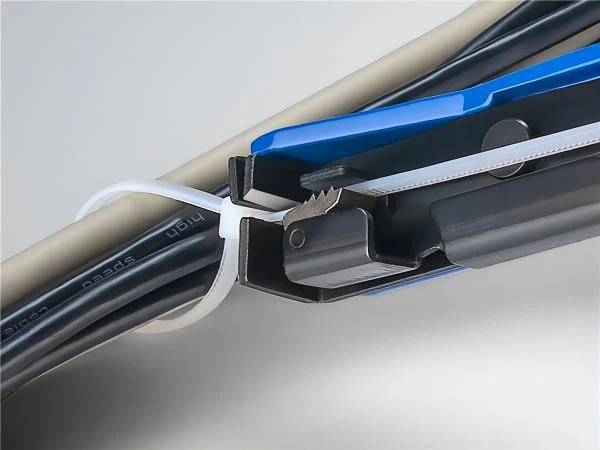
| Usage: | First, the cable is bundled in the nylon cable tie; Next,the tail of the nylon cable tie is clamped by the tool; Finally, tighten with tool |
| Delivery time: | 3-15 days (Depend on your order quantity) after confirm order. |
| Payment terms: | T/T,Western Union,L/C ,PayPal |
| Model: | 2.5x80mm ~ 12.0x1200mm |
| Packing: | Stander 100pieces/bags |
| G.W.: | About 19kgs |
| N.W.: | About 18kgs |
| Carton Means: | Stander 54*32*30(cm) |
Product Parameter Introduction
| Tensile Strength:40lbs(18kgs) | ||||
| Model | L | W | E | |
| ITEM NO. | INCH | MM | MM | BUNDLE DIAMETER MM |
| GD-3.6X140 | 5.5" | 140 | 3.6 | 3-33 |
| GD-3.6X150 | 6.0" | 150 | 3-35 | |
| GD-3.6X180 | 7.1" | 180 | 3-42 | |
| GD-3.6X200 | 8.0" | 200 | 3-50 | |
| GD-3.6X250 | 10" | 250 | 3-65 | |
| GD-3.6X280 | 11" | 280 | 3-70 | |
| GD-3.6X300 | 12" | 300 | 3-80 | |
| GD-3.6X370 | 14.6" | 370 | 3-105 | |
Products Application
Cable Management: One of the most popular uses for zip ties is in organizing and securing cables. Whether in an industrial setting, a data center, or a home office, zip ties help keep cables neat and prevent tangling. They are especially useful for bundling multiple cables together and affixing them to walls, racks, or other surfaces to reduce clutter and enhance safety.
Packaging and Bundling: Zip ties are frequently used in packaging to bundle products, secure bags, or close boxes. Their strong grip ensures that items stay together during transport or storage. They are also employed in agriculture, where they can be used to tie plants to stakes or trellises, or to bundle harvested produce for shipment.
Automotive and Marine Applications: In the automotive and marine industries, zip ties are used to secure wiring harnesses, hoses, and other components. Their resistance to oils, greases, and varying temperatures makes them ideal for these environments. For marine applications, specialized zip ties made from materials resistant to saltwater corrosion are available.
Construction and DIY Projects: Zip ties are a staple in construction and DIY projects due to their versatility. They can be used to temporarily hold parts together, secure tarps or coverings, attach signs to fences, and even as a quick fix for broken items. Their ease of use and strength make them invaluable for both professional builders and hobbyists.


Product raw materials and certifications
Our company is proud to announce that our cable tie products have successfully passed UL certification and received file number E534653. UL certification is a certification issued by the world's leading safety science company, indicating that products meet the highest quality and safety standards. This certification ensures the superior performance and reliability of our cable tie products!

Products raw material suppliers

High Quality Raw Material Supply
Our company's raw material supplier for nylon cable ties is INVISTA, a world-leading chemical intermediates manufacturer focusing on the nylon and polypropylene value chain. With more than 80 years of nylon production experience, INVISTA provides high-quality nylon polymers and fibers for use in a variety of applications and end products, such as automotive, electronics, medical, packaging and apparel.


Our Production Factory

Crafting Durable and Reliable Nylon Cable Ties
Our nylon cable tie manufacturing factory stands out for its rigorous quality assurance. With cutting-edge facilities and a seasoned team, we adhere to strict standards throughout the production process, from meticulous raw material selection to stringent quality checks. This commitment ensures that each product meets the highest quality benchmarks, providing our customers with nylon cable ties that excel in durability and reliability.
FAQ:
What are the primary materials used in the construction of zip ties, and why are they chosen?
They are primarily made from nylon 6/6 due to its excellent balance of strength, flexibility, and resistance to chemicals, oils, and greases. Nylon 6/6 also has a high melting point, making it suitable for use in high-temperature environments. Additionally, UV-resistant variants are available for outdoor use, offering durability against prolonged sun exposure.
How does the locking mechanism in zip ties work, and what ensures a secure hold?
The locking mechanism in zip ties consists of a ratchet or pawl within the head that engages with the serrated teeth along the strip. As the strip is pulled through the head, the mechanism allows movement in only one direction, forming a secure loop that cannot easily be undone. This design ensures a tight grip on bundled objects.
What are the potential risks of over-tightening standard zip ties, particularly when used with cables?
Over-tightening zip ties can damage the materials they secure, especially cables. Excessive pressure on cables can lead to signal interference, breakage, or even permanent damage to the internal wiring, which may compromise the functionality of the cables.
Are they reusable, and what alternatives are available for applications requiring multiple uses?
Most zip ties are designed for single-use, meaning they cannot be reused once cut. For applications that require reusability, special reusable zip ties with a release mechanism are available. These ties can be easily undone and reused without cutting, making them a more sustainable option in certain scenarios.
In what environments might standard nylon zip ties not be suitable, and what alternatives are recommended? Standard nylon zip ties may not be suitable for extremely high-temperature environments or situations requiring fire resistance. In such cases, alternatives like stainless steel zip ties or Teflon-coated ties are recommended. These materials offer enhanced durability and resistance to heat and fire, making them suitable for more demanding applications.
Hot Tags: standard zip ties, China, suppliers, manufacturers, factory, custom, wholesale, double head zip tie, 50mm velcro, Self Locking Nylon Cable Ties, Mounting Cable Tie, self locking plastic straps, nylon twist ties
You Might Also Like


