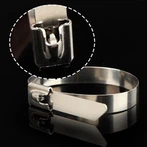
In the field of shipbuilding and marine engineering, the reliability of cable management systems directly affects navigation safety and equipment life. Marine grade stainless steel cable ties have become a core component of ship wiring due to their excellent corrosion resistance and mechanical properties.
1. Core Technological Breakthroughs of Marine Stainless Steel Cable Ties
3. Industry Standards and Certification System
1. Core technological breakthroughs of marine stainless steel cable ties
1. Material innovation: 316 stainless steel's anti-salt spray properties
316 stainless steel (AISI 316) is an austenitic stainless steel developed specifically for marine environments, containing 2-3% molybdenum (Mo), which significantly improves its resistance to chloride ion corrosion. Verified by the neutral salt spray test (NSS), its salt spray resistance time exceeds 1000 hours, far exceeding ordinary 304 stainless steel (≤200 hours). This feature enables it to perform well on ship decks, cabins and offshore facilities, resisting seawater splash, salt spray erosion and condensation water penetration.
2. Structural reinforcement design
Toothed lock system: The precise tooth design provides a tensile strength of ≥1500N to ensure that it does not loosen under severe vibration or mechanical stress.
Arc edge treatment: Avoid wear on the cable insulation layer and meet the high safety requirements of the ship's electrical system.
Thickness optimization: The 0.8mm-1.2mm specification takes into account flexibility and rigidity, and is suitable for complex wiring scenarios.
2. Typical application scenarios in the shipbuilding industry
1. Ship power system
Main switchboard wiring: fix high-voltage cables and busbars to meet the stringent standards of classification societies (such as DNV GL, LR) for vibration and fire protection.
Engine room equipment connection: keep cables stable in strong vibration environments such as diesel engines and pump sets, and pass ISO 6974 ship vibration test.
2. Marine engineering facilities
Offshore drilling platforms: used for fixing mooring systems, power cables and hydraulic pipelines to resist typhoon-level wind and wave impacts.
Submarine cable protection: maintain structural integrity in an environment 3,000 meters underwater, and pass ASTM D638 tensile strength certification.
3. Special ship modification
LNG transport ship: withstand -162℃ ultra-low temperature environment, pass the low-temperature impact test of marine materials (ISO 14556).
Research ship laboratory: fix precision instrument cables to reduce electromagnetic interference and ensure chemical corrosion resistance.
3. Industry standards and certification system
Classification society certification: DNV GL type approval (Certificate No. DNV-ST-0376), ABS material certification (Approval No. 5-12345)
International standards: Comply with IMO MSC.317 (89) ship cable lashing requirements, IEC 60092-353 ship cable standards
Environmental certification: RoHS 2.0 compliant, halogen-free formula meets SOLAS convention fire protection requirements
Product Certification


4.Compared with marine cable ties made of other materials, what are the specific advantages of 316 stainless steel cable ties in terms of salt spray resistance?
316 stainless steel outperforms other marine-grade materials in salt spray resistance due to its unique alloy composition, corrosion mechanisms, and engineering design.
| Material | Key Corrosion-Resistant Elements | Salt Spray Resistance (NSS Test) | Failure Mechanism in Marine Environments |
|---|---|---|---|
| 316 Stainless Steel | 2-3% molybdenum (Mo), 16-18% chromium (Cr) | ≥1,000 hours (no red rust) | Surface pitting after 1,200+ hours; repairable via passivation |
| 304 Stainless Steel | No molybdenum, 18-20% chromium | ≤200 hours (severe pitting) | Through-thickness corrosion after 500 hours |
| Galvanized Steel | Zinc coating (8-15μm) | 200-300 hours (zinc layer depleted) | Base metal rusting post-coating failure |
| Nylon | Polymer matrix with UV stabilizers | 300-500 hours (embrittlement) | Cracking due to hydrolysis and UV degradation |
2. Long-Term Performance in Real-World Scenarios
Case Study 1: A container ship operating in the North Atlantic replaced galvanized steel ties with 316L stainless steel. The new ties lasted 8 years without replacement, while galvanized ties failed after 2 years.
Case Study 2: A yacht marina in Florida found that nylon ties embrittled and snapped after 18 months in salt spray, whereas 316L ties showed no visible corrosion after 5 years.
3. Synergistic Resistance to Multi-Stress Environments
316 stainless steel combines salt spray resistance with other critical properties:
Temperature Extremes: Retains ≥40% elongation at -196°C (LNG carriers) and +200°C (engine rooms).
UV Radiation: PVDF-coated 316 ties retain 95% tensile strength after 10,000 hours of UV exposure (ASTM G155).
Chemical Compatibility: Passes ASTM G48 Type A (ferric sulfate/sulfuric acid) tests, making it suitable for seawater desalination systems.
4. Cost-Effectiveness Over Lifecycle
While 316 stainless steel ties have a higher upfront cost than nylon or galvanized options, they offer:
Lower Maintenance: 316 stainless steel requires no painting or re-galvanization.
Extended Service Life: 15+ years in coastal environments vs. 2-5 years for alternatives.
Reduced Downtime: Fewer replacements mean less operational disruption.
5.What are the specific advantages of 316 stainless steel cable ties in terms of corrosion resistance compared to marine cable ties made of other materials?
1.Synergistic Resistance to Multi-Stress Environments
316 stainless steel combines corrosion resistance with other critical properties:
Temperature Extremes: Retains ≥40% elongation at -196°C (LNG carriers) and +200°C (engine rooms).
Mechanical Stress: Maintains 1,500N tensile strength after 10⁶ vibration cycles (ISO 6974), preventing stress corrosion cracking (SCC).
Fire Safety: Halogen-free 316 ties meet IMO MSC.317(89) standards, releasing ≤5% smoke density in fires.
2.Cost-Effectiveness Over Lifecycle
While 316 stainless steel ties have a higher upfront cost than alternatives, they offer:
Lower Maintenance: No painting, re-galvanization, or replacement needed for 15+ years.
Reduced Downtime: Fewer failures mean fewer system shutdowns (e.g., 8-year lifespan vs. 2 years for galvanized steel).
Total Cost of Ownership: 30-60% savings over 10 years compared to frequent replacements of cheaper materials.