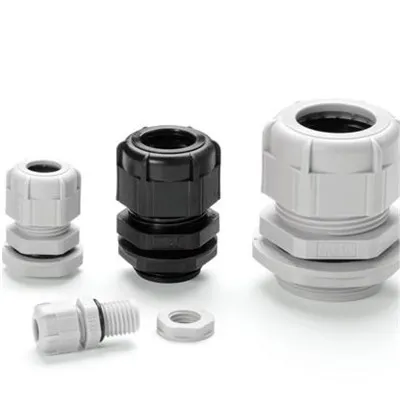
Cable connectors come in various thread standards, and choosing the correct thread standard is crucial for compatibility, sealing performance, and safety. The three most commonly used thread types worldwide are NPT, PG, and metric (M).
1. What Is NPT Thread? (National Pipe Thread)
NPT (National Pipe Tapered) is a U.S. standard defined by ANSI/ASME. This thread type is tapered, meaning the diameter becomes narrower toward the end. When the male and female threads tighten, they create a mechanical seal through interference fit.
Key Features of NPT Threads
Tapered thread design for tight sealing
Typically requires PTFE/Teflon tape or thread sealant
Strong mechanical locking
Sizes measured in inches (1/4", 3/8", 1/2", 3/4", 1", etc.)
Widely used in the USA, Canada, Mexico, petroleum plants, heavy industry, and military equipment
Advantages
Excellent sealing performance under pressure
Suitable for gas lines, liquid pipes, and high-pressure environments
Very secure connection; resistant to vibration
Limitations
Harder to assemble compared to straight threads
Cannot be easily adjusted after installation
Requires careful tightening to avoid leaks
Best Use Cases
Oil & gas installations
Fire protection systems
Industrial machinery
Outdoor and high-pressure applications
North American equipment where NPT is the standard


2. What Is PG Thread? (Panzer-Gewinde)
PG (Panzer-Gewinde) is an older German standard used mainly in Europe for electrical connections. PG threads have a rounded profile and are traditionally used for cable protection systems.
Key Features of PG Threads
Round-thread profile
Comes in sizes like PG7, PG9, PG11, PG13.5, PG16, PG21, PG29
Common in older European machinery
Designed for electrical conduit and cable glands
Advantages
Easy to assemble
Smooth rounded thread reduces wear
Long history of use in electrical cabinet wiring
Limitations
Being replaced by M threads in many industries
Limited availability in certain countries
Not ideal for high-pressure sealing
Best Use Cases
Older European machines and cabinets
Replacement parts for legacy systems
Electrical distributors following PG standards
3. What Is Metric Thread? (M Thread / ISO Standard)
Metric (M) threads follow ISO 262 and ISO 965 standards and are the most widely used thread type in the world today.
Key Features of Metric Threads
Straight (parallel) thread design
Measured in millimeters (M12, M16, M20, M25, M32, M40, etc.)
Uses an O-ring for sealing
Standardized worldwide
Compatible with modern machinery and electrical equipment
Advantages
Universally recognized
Easy installation and removal
Excellent sealing with O-rings
Wide size range for small and large cable glands
Replaces PG in many IEC-based electrical applications
Limitations
Not interchangeable with NPT or PG
Must match the panel hole size precisely
Best Use Cases
Industrial control cabinets
Automation equipment
Machinery manufacturing
Renewable energy installations
Marine and offshore connections
4. Comparison Table: NPT vs. PG vs. Metric Thread
| Feature | NPT Thread | PG Thread | Metric (M) Thread |
|---|---|---|---|
| Thread Type | Tapered | Round | Straight |
| Seal Type | Mechanical + sealant | Basic sealing | O-ring sealing |
| Measurement | Inch | German system | Millimeter |
| Best Region | USA, Canada | Europe (old systems) | Worldwide |
| Strength | Very strong seal | Moderate seal | High reliability |
| Availability | High in Americas | Limited globally | Widest availability |
| Applications | High-pressure, oil & gas | Legacy electrical | Modern machinery, cabinets |
5. Which Thread Type Should You Choose?
Choosing the correct thread type depends on your equipment, installation region, and performance requirements.
Choose NPT If:
The project is in North America
You need a pressure-tight connection
Equipment specifications require NPT only
Examples: Oil refineries, chemical plants, heavy machinery, gas lines.
Choose PG If:
You are repairing or replacing parts on older European equipment
The electrical cabinet or conduit system specifically uses PG
You are working with distributors in niche markets
Examples: Legacy equipment, old control panels, German-made machines before 2000.
Choose Metric (M) If:
You are working on new machinery or global industrial equipment
The application requires modern standards and easy sealing
You want the most future-proof and widely compatible thread type
Examples: Automation, robotics, solar energy, marine, electrical panels, OEM manufacturing.
6. Final Recommendation: The Best Thread Type for Most Buyers
If the application does not require a specific standard, Metric (M) thread cable glands are the safest and most universal choice. They offer the best balance between:
Compatibility
Easy installation
Global availability
Future-proof design
Reliable O-ring sealing
However, always follow the specifications of the equipment manufacturer to avoid mismatch or unsafe installations.
7.Engineering principles, global standards, and practical selection guide for NPT, PG, and metric cable connector threads.
1. Understanding Thread Geometry and How It Affects Sealing
The most fundamental difference between NPT, PG, and Metric threads lies in their geometry.
Thread geometry directly determines how well the cable gland seals, how tightly it locks into a panel or enclosure, and how it performs under vibration, pressure, or thermal expansion.
NPT Thread Geometry
NPT threads are tapered, typically at a 1°47′ angle. This taper is what allows the threads to wedge tightly together. When the male NPT cable gland is screwed into a female NPT connector or enclosure, the contact surface increases as it tightens, producing a pressure-tight seal. This is why NPT is popular in gas systems, oil pipelines, and other pressurized environments.
However, this design also means:
The installer must apply PTFE tape or sealant.
Over-tightening can crack plastic enclosures.
Under-tightening results in leakage.
PG Thread Geometry
PG threads use a rounded profile with shallower depth. Because the threads are not tapered, PG connections rely mostly on tightening force, surface area, and locknuts to achieve a seal. The rounded threading reduces friction and is gentle on softer materials, which is why PG was common in early electrical cabinets.
Metric Thread Geometry
Metric threads have a triangular profile (60° flank angle) and a straight (parallel) thread design. Sealing is achieved through:
a flat washer or O-ring compressed between the gland and enclosure
the wide contact surface of the metric thread
This makes Metric glands very reliable for IP67, IP68, and IP69K waterproof and dustproof systems.
2. Global Standardization and Why the Market Prefers Metric Threads Today
Worldwide, different standards organizations influence thread selection:
NPT → ANSI/ASME (USA, Canada, Mexico)
PG → DIN 40430 (older European standard)
Metric (M) → ISO 262 / ISO 965 (global standard)
In the last 20 years, Metric threads have become the dominant standard, especially in Asia, Europe, Middle East, and South America. This shift happened for several reasons:
A. ISO Standardization
Most industrial equipment manufacturers prefer ISO standards because they are globally accepted and simplify export requirements.
B. Easier Integration With Enclosures
Metric threads fit easily into:
aluminum junction boxes
stainless steel panels
ABS or polycarbonate enclosures
plastic terminal blocks
Metric threads also minimize the risk of cross-threading.
C. Waterproof System Requirements
As industries adopt IP67–IP69K waterproof specifications:
Metric glands provide more consistent sealing
The O-ring design ensures stable performance
D. Replacement for PG Threads
Modern equipment is increasingly transitioning away from PG threading, making M threads the preferred upgrade path for both electrical and mechanical manufacturers.
3. Application-Based Selection: Matching Thread Type to Industry Use
To choose the proper thread type, buyers should consider the environmental and operational conditions.
NPT: Best for High-Pressure and Harsh Environments
NPT threads excel in:
petroleum and petrochemical plants
offshore rigs
boiler rooms
heavy-duty industrial power stations
high-pressure fluid systems
Because of the tapered thread, NPT handles vibration and pressure extremely well.
PG: Best for Legacy Electrical Systems
PG threads remain relevant mainly when:
OEM equipment is older than 2000
German or European legacy panels require replacements
Local codes or panel cutouts use PG sizing
This standard continues to exist but is becoming less common for new designs.
Metric: Best for Modern Machinery and Global Production
Metric threads are the default choice for:
new electrical panel manufacturing
solar and wind energy installations
EV charging stations
automation systems
robotics and CNC machines
lighting systems
marine & offshore electrical systems
telecom and base stations
Metric glands integrate easily with today's global production requirements.
4. Material Compatibility: How Thread Type Interacts With Enclosure Materials
Thread performance also depends on the enclosure material:
Metal Enclosures
Metric threads provide a reliable O-ring seal
NPT threads work well if the enclosure wall is thick enough
PG threads may loosen under vibration
Plastic Enclosures (ABS, PC, PVC)
Metric threads are safest because they require less torque
NPT threads must be installed carefully to avoid cracking
PG threads provide good compatibility with soft materials
Thin-Wall Panels
In thin-wall or sheet-metal panels:
Metric threads offer the most stable engagement
NPT may not fully taper before reaching maximum torque
PG may require additional locknuts
5. Installation and Maintenance Differences
NPT Installation
Requires sealant or PTFE tape
Harder to adjust after installation
Cannot be easily repositioned
PG Installation
Simple but becoming outdated
Less secure for high-vibration environments
Metric Installation
Fast and precise
O-ring provides stable compression
Suitable for waterproof applications
Because maintenance cost matters in industrial facilities, many engineers prefer Metric glands for long-term reliability.
6. Final Expert Recommendation: Future-Proof Your System With Metric Threads
While NPT and PG threads still play important roles, the global trend clearly favors Metric (M) thread cable glands.
Choose NPT only when:
The equipment is North American
You need pressure-tight seals
The specification mandates NPT
Choose PG only when:
You are repairing or replacing legacy devices
The enclosure already has PG cutouts
Choose Metric when:
You need universal compatibility
You want easy waterproof sealing
You manufacture products for global markets
Metric threads deliver the best balance of:
safety
installation efficiency
long-term sealing performance
international standardization
This makes Metric thread cable glands the most future-proof choice for 95% of modern applications.